




Tolerances
General tolerances
Due to the manufacturing process, larger tolerances are required for extruded elastomers, sheets, stamped or water jet cut parts, and circular cut sections. If these tolerances are too large for the application, it should be checked whether manufacturing from the mold (molded part) is an option.
We are happy to advise you.
Tolerances for molded rubber parts
The manufacturing tolerances for molded parts are specified in the DIN ISO 3302-1 standard.
These tolerances are divided into four classes, from class M1 (very fine) to M4 (coarse).
Within these classes, the standard also differentiates between dimensions that are form-dependent (F) and those that are fit-dependent (C). Due to manufacturing constraints, fit-dependent dimensions cannot be produced within the same tight tolerances as form-dependent dimensions.
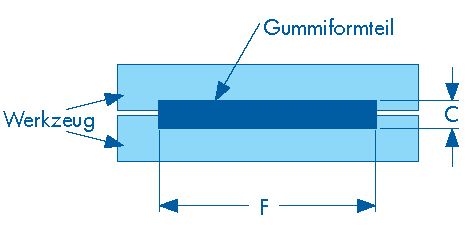
Tolerances according to DIN 3302-1 M1 (very fine)
In order to manufacture molded parts in tolerance class M1 (very fine), high-precision tools with few cavities and reproducible process parameters are required.
Tolerances according to DIN 3302-1 M2 (fine)
For tolerance class M2 (fine), precisely manufactured tools that allow for a larger number of cavities and reproducible process parameters are required.
Tolerances according to DIN 3302-1 M3 (medium)
Today's production facilities and tools are perfectly adequate for easily complying with tolerance class M3. Therefore, no special requirements need to be taken into account for the manufacture of molded parts in this tolerance class.
Tolerances according to DIN 3302-1 M4 (coarse)
As dimensional accuracy requirements have increased over the years, this tolerance class is hardly used anymore.